
Every time I watch classic sci-fi, one detail sticks out to me. When Tony Stark talks to Jarvis, he isn't staring down at a phone screen. Jarvis lives on room-scale displays and floats in the ambient air. When Tony walks into the room, the walls light up. In *Minority Report*, John Anderton stands in front of a massive wall, flicking data across space with gestures.
<div class="aice-quick-answer" style="background:#f0f7ff;border-left:4px solid #2563eb;padding:1
Sci-fi got it right: AI was never meant to be squeezed into a 6-inch glass box. It belongs in physical space, where you can look up and interact with it naturally.
After years of founding and building AI hardware, I’m convinced of one core premise: AI’s real home court is the big screen, not the smartphone.
Smartphones are inherently private and isolated—you hold them close to your face. Big screens are spatial and shared—they engage an entire room. Reading bedtime stories, going through interactive picture books, or teaching a classroom full of students are activities that naturally demand looking up together, not staring down alone.
From Utility to Companion
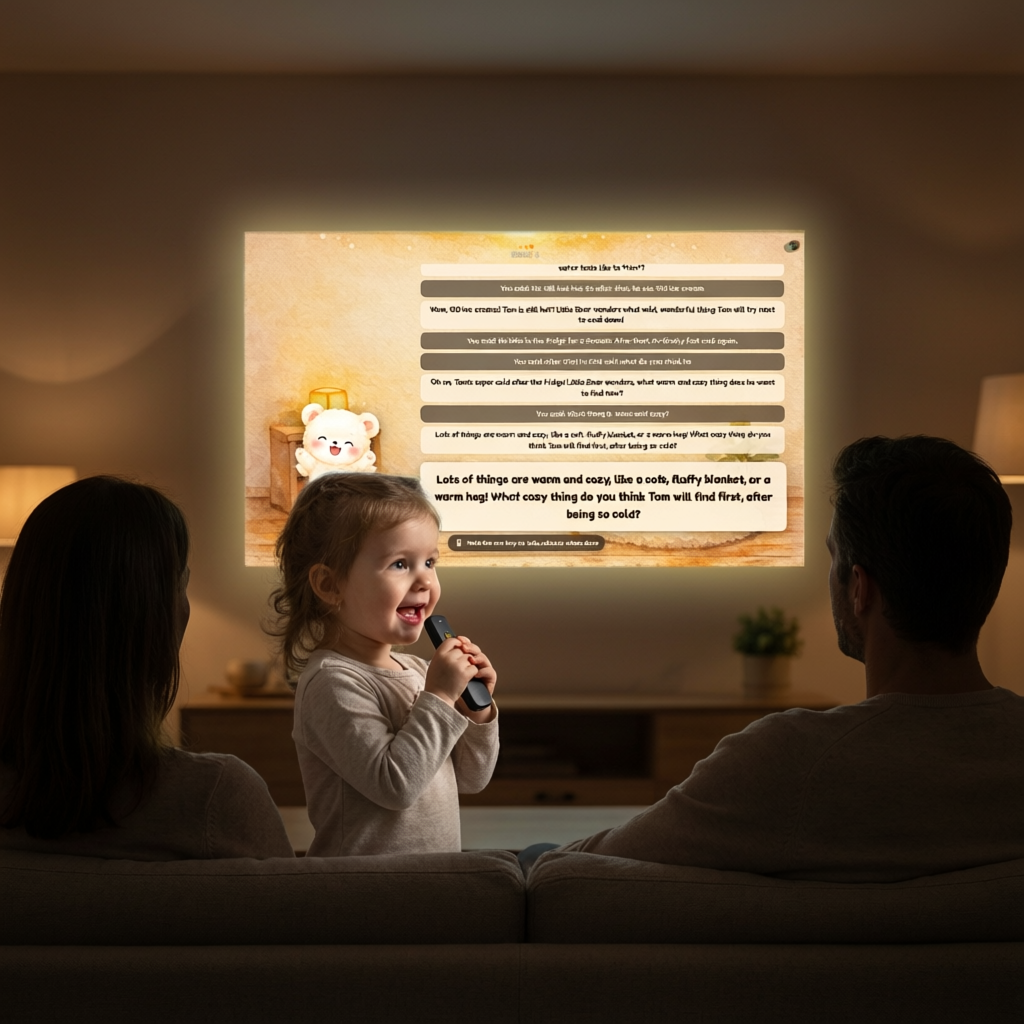
Right now, I’m building an AI projector. It takes AI-generated stories, interactive picture books, and guided lessons, and projects them wide across a wall. Kids don't have to hunch over a tiny screen; they just look up.
My biggest takeaway from building this over the past six months? The exact same AI feels like a transactional tool on a smartphone, but on a large screen, it turns into a living companion.
What brings that big screen to life is a digital avatar—a visible AI presence with expressions, voice sync, and real-time movement. On a phone screen, an avatar is just a tiny, squished thumbnail. On a wall, the scale changes everything. You aren't just listening to a voice; you are sharing space with someone who is looking right back at you.
Rethinking Kids' Learning
Education is the killer use case I’m most bullish on.
The biggest drawback of early childhood tech is screen habits: kids slouching over phones, straining their eyes, and losing focus. A projected big screen pushes the content back and scales it up. AI tutors, smart storybooks, and immersive lessons unpack across the entire wall. Kids sit up straight, follow along visually, and speak out loud to respond.
Transforming AI from a phone-based tutor into a wall-projected classroom experience isn't just an incremental feature update—it's a fundamental shift in how kids interact with technology.
Display Tech is Finally Catching Up
Display technology has reached a tipping point, giving AI novel ways to interface with physical spaces:
- Laser Projection: Ultra-bright engines mean clear, crisp visuals even in daytime living rooms and bright classrooms.
- Transparent Displays: Avatars float in front of real environments, making AI guides feel physical in retail stores and showrooms.
- Micro-LED: Delivers hyper-bright, fine-grained visual details at massive scale.
- Glasses-Free 3D: Adds realistic depth to conversational digital humans.
Displays are becoming larger, brighter, 3D, and integrated into physical architecture right when AI needs space to stretch out. These two trajectories colliding isn't a coincidence.
The Hardware Bottlenecks Are Real
In the next few years, dedicated AI screens will become standard across homes, classrooms, and showrooms—run by conversational digital humans that listen, respond, teach, and guide.
Today’s smart projectors, interactive touchboards, and TV streaming boxes are early prototypes of this future.
Of course, bridging the gap between vision and production means walking through a minefield of technical hurdles. I’ve personally run into all of them:
- Legacy WebViews failing to handle real-time audio streaming smoothly
- Severe frame-rate drops when rendering dynamic digital avatars on embedded chipsets
- Terrible far-field voice pickup in acoustically noisy rooms
I’ll break down how we solved these hardware and software bottlenecks in my next post.
***
*I’m an AI hardware founder building conversational toys, kids’ tech, and smart AI projectors. If you’re building in AI hardware, smart displays, digital avatars, or edtech, I’d love to connect. This is a space worth betting on early.*