
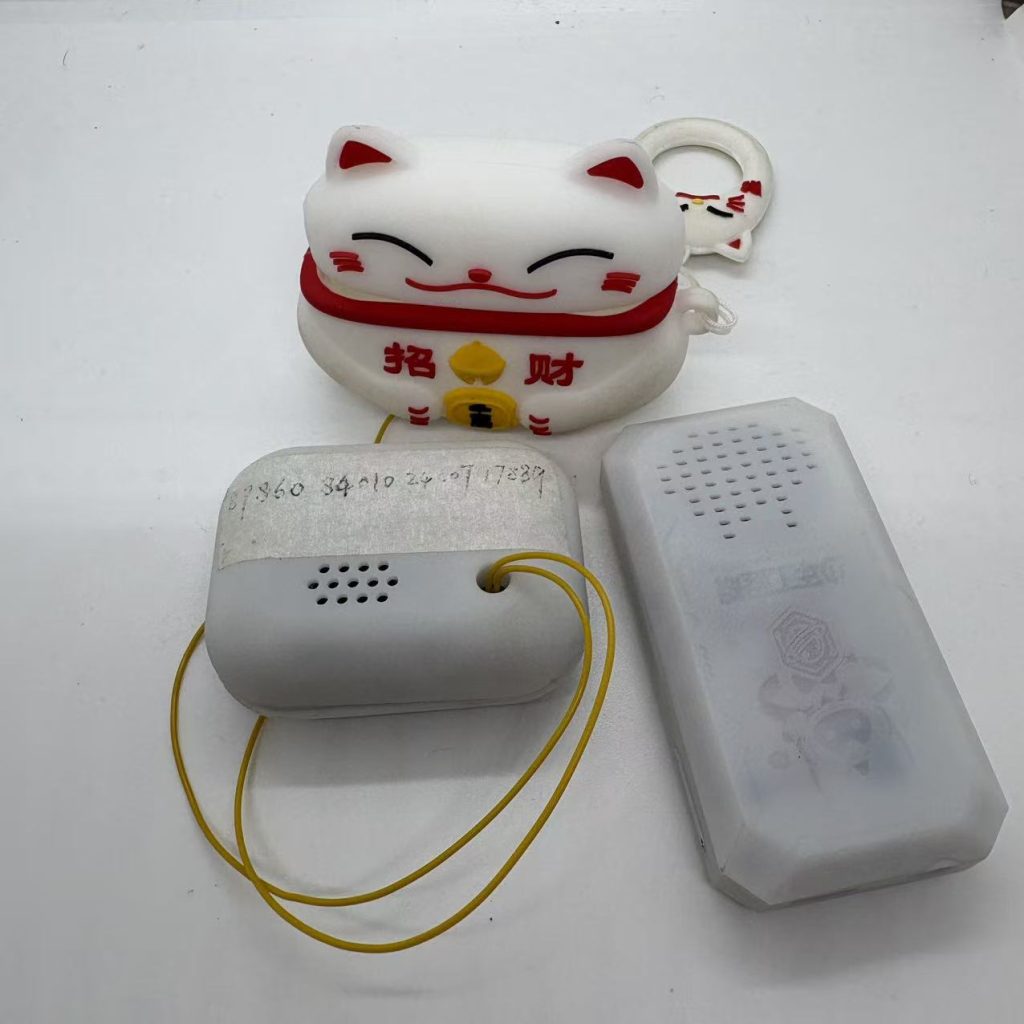
My first AI voice toy was designed to feel exactly like an Apple AirPods charging case—sleek, compact, and fitting perfectly in the palm of your hand.
<div class="aice-quick-answer" style="background:#f0f7ff;border-left:4px solid #2563eb;padding:14px
Then we took it outside for a field test.
The audio played, but you had to literally press the device against your ear to hear what the AI was saying.
My heart sank. For an AI voice companion, the voice *is* the product. If the speaker is whisper-quiet, nothing else matters. If a kid is running around a living room and can't hear the toy replying from two meters away, the product is dead on arrival.
I spent a massive amount of time agonizing over this, eventually redesigning both the aesthetics and the internal structure from scratch. Here is the hard lesson I learned so you don't have to make the same mistake.
You Can't Negotiate with Physics
When it comes to hardware, volume and physical size are bound by the laws of physics. There is no engineering hack around this. The smaller the speaker, the less air it pushes, and the quieter the sound. To get decent volume, you need a certain diaphragm surface area and a minimum acoustic cavity volume.
Even with Apple’s budget and world-class engineering, you cannot bypass these acoustic constraints.
My initial, naive assumption was: *Let’s make the device look beautiful first, and we can just tune the amplifier later to boost the volume.*
This was a massive mistake.
While you can push more power through a tiny speaker using a功放 (amplifier) IC, the speaker driver has to be able to handle it. Violently forcing power into an undersized speaker just results in clipping, crackling, and heavy distortion. You might get louder sound, but it will sound like a broken, cheap radio. The user experience actually gets worse.
"Apple Ambitions, Shenzhen Resources"
Next, I looked into high-end smartphone-grade amplifier ICs. They sound incredible, but their cost and footprint are completely prohibitive for a mass-market consumer toy.
Every hardware iteration costs real money. Trying to squeeze high volume out of a tiny, distortion-free enclosure gets exponentially more expensive the further you push it.
To put it bluntly: I had Apple-level design ambitions, but I was working with the resources of a small Shenzhen startup. It’s a painful truth, but it’s the reality.
I was stuck in a loop for weeks. I was deeply attached to my ultra-compact design, but the reality was that it simply didn't work. I wanted both form and function, but physics refused to compromise.
The Pivot: Prioritizing the Core Experience
Ultimately, I had to ruthlessly prioritize.
For an AI companion, clear audio is the absolute baseline. If a user has to cuddle the device to their ear just to understand the AI, the product is a failure, no matter how cute it looks on a desk.
So, we made the hard pivot:
- We upgraded the amplifier IC.
- We redesigned the internal acoustic chamber.
- We swapped the speaker driver.
- We opted for an exposed, external speaker grill design.
The final device is slightly bulkier than my original vision, but the sound is finally there. Standing two meters away outdoors, the voice is crisp, clear, and completely distortion-free.
The Reality of Building Hardware
Sometimes, hardware development is about accepting constraints. It’s not that your vision is bad; it’s just that your current resources, unit economics, and development cycles don't allow you to have it all. Apple can pack incredible sound into tiny AirPods because they have massive R&D budgets, multi-year timelines, and custom silicon. Startups don't.
If you are currently building consumer electronics or AI hardware, how do you handle the inevitable clash between industrial design and core functionality? Let's discuss in the comments.
If you found this honest breakdown helpful, drop a like, and I'll share more behind-the-scenes engineering trade-offs from building Amis in my next post.