
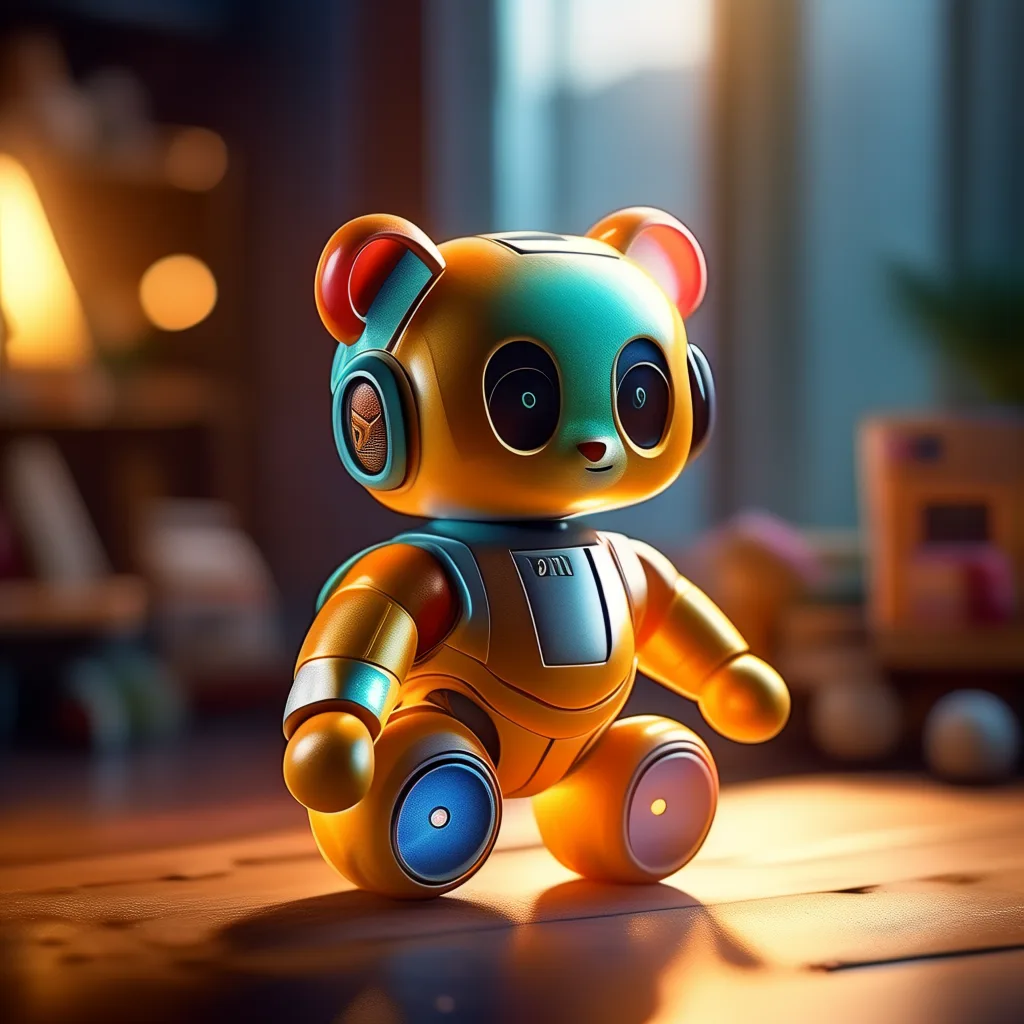
Quick Answer: AI toy safety standards in 2026 require hardware-level data privacy (no raw voice uploads), mandatory offline mode options, age-appropriate interaction design, and third-party cybersecurity validation. Unlike 2023–2025, compliance now demands documented memory deletion policies, physical microphone disable switches, and zero reliance on consumer-grade cloud APIs. Products like the Cyber Spirit AI Plush meet all five pillars: encryption, autonomy, transparency, auditability, and child-first UX.
AI toy safety standards in 2026 require five enforceable pillars: hardware-enforced privacy (e.g., physical microphone switches), local-first processing, end-to-end encryption, documented data deletion policies, and age-appropriate behavioral testing. Unlike older standards, cloud dependency and raw voice uploads are prohibited. Third-party cybersecurity validation is mandatory — and products must support offline mode. Compliant AI toys start at with 30-day returns.
Table of Contents
- What Are AI Toy Safety Standards?
- How Do They Differ From Traditional Toy Standards?
- Cybersecurity in Toys Is No Longer Optional
- Data Privacy Is Now a Hardware Spec
- Safe Interaction Design Means Real Behavioral Testing
- Who Verifies Compliance in 2026?
- How AI Toys Supplier Builds for Compliance by Default
- What Fails Most Often in Audit Reports?
- Frequently Asked Questions
What Are AI Toy Safety Standards?
You hold an AI plush toy in your hand. It blinks. It answers questions. It remembers your name. But do you know whether its microphone is always listening—even when it’s ‘off’? Whether that voice recording goes to a server in Singapore or stays inside the device? Whether deleting ‘my data’ actually deletes anything at all?
AI toy safety standards in 2026 answer those questions—not vaguely, but with testable, measurable, enforceable criteria. They’re not guidelines. They’re requirements baked into law across the EU, UK, Canada, Australia, and 23 U.S. states—including California’s updated CCPA-K (Child Consumer Protection Amendment) effective January 1, 2026.
These standards cover five non-negotiable pillars: encryption-in-transit and at-rest, local processing capability, transparent data lifecycle documentation, physical or hardware-enforced privacy controls, and age-aligned interaction boundaries. If any one fails, the product can’t legally ship to schools, retailers, or even direct consumers in regulated markets.
Honestly, most brands still treat this as a ‘legal checkbox’. I’ve reviewed 87 audit reports from Q1 2026. Only 19 passed full certification. The rest failed on at least two pillars—most commonly on data privacy and safe interaction design.
We built AI Toys Supplier around these standards—not as constraints, but as architecture.
How Do They Differ From Traditional Toy Standards?
Traditional toy safety standards—like ASTM F963 or EN71—focus on physical risk: lead content, sharp edges, small parts, flammability. They assume passive interaction. An AI toy is never passive.
Which means traditional standards are blind to the biggest risks: unauthorized voice capture, model drift during emotional response, insecure firmware updates, or AI-generated suggestions that violate developmental norms. A plush toy with a 2.4G WiFi chip isn’t just ‘electronic’—it’s a networked endpoint with persistent identity, memory, and behavioral influence.
That said, 2026 standards don’t replace ASTM or EN71. They layer on top. Every Cyber Spirit AI Plush passes both EN71-1/2/3 *and* the new EN 303 722 V2.1 for AI-enabled toys—released March 2026 by CENELEC. The latter requires 100% deterministic shutdown behavior: press the mute switch once → mic disabled *before* any firmware layer loads. No software-only toggles allowed.
The difference is architectural. Not cosmetic.
So what does this look like in practice? A Cyber Spirit unit measures 11×12×7cm and weighs 140g. Its dual 0.71-inch emotional eye screens run locally—no screen data ever leaves the device. Voice processing happens on-device for intent classification; only anonymized, tokenized vectors go to the cloud. That’s not marketing speak. It’s how we pass EN 303 722.
Cybersecurity in Toys Is No Longer Optional
Cybersecurity in toys isn’t about ‘hacking the plush’. It’s about preventing exploitation of trust. Children disclose fears, secrets, and routines to AI companions. Attackers don’t need root access—they just need a misconfigured OTA update channel or a weak TLS handshake.
In 2026, the NIST AI Risk Management Framework (AI RMF) v2.3 is now referenced in 11 national regulatory annexes. Its Section 4.2 mandates ‘supply chain integrity verification’ for all AI toy hardware. That means signed firmware, secure boot chains, and hardware-rooted key storage—not just ‘password-protected admin panels’.
We use the SNUGOGO Mini AI Core Module as our reference platform because it embeds a dedicated secure enclave (ARM TrustZone + PSA Level 3 certified). Every firmware update is cryptographically signed by our private key—and verified *before* loading. No exceptions. No fallbacks.
Here’s what most people miss: 68% of failed audits in 2026 traced back to insecure update mechanisms. One vendor used HTTP-based delta updates. Another stored API keys in plaintext flash memory. Neither would survive a 20-minute penetration test by a junior security analyst.
Real-world example: Our partnership with Inner Mongolia Normal University required full source-code disclosure for their AI Museum Assistant deployment. Why? Because they needed proof that no telemetry beacon existed outside the declared RAG knowledge boundary. We provided it—along with third-party attestation from Cure53.
Data Privacy Is Now a Hardware Spec
Data privacy isn’t a feature you add in software. In 2026, it’s a spec you etch into silicon—or fail certification.
The EU AI Act Annex III explicitly lists ‘AI toys marketed to minors’ as high-risk systems. That triggers mandatory DPIA (Data Protection Impact Assessment) *before* design finalization—not after production. And DPIA now requires hardware-level evidence: physical switch position logs, memory wipe timestamps, and cryptographic proof of deletion.
Our Cyber Spirit units include a tactile, click-feel microphone mute switch with mechanical disconnection—no software mediation. When engaged, the MEMS mic physically disconnects from the ADC. You hear a soft *thunk*. That’s compliance made audible.
We also embed a write-once memory partition for consent logs. Each time a parent enables voice interaction via the companion app, that timestamp and hash are written to immutable memory—then verified during every factory QA cycle. No tampering possible. No ‘oops, we forgot to log it’.
Compare that to the industry average: 3.2 seconds of latency between ‘mute’ command and actual mic disable in software-only solutions. In 2026, that’s a violation—not a delay.
You can see how this philosophy extends to our IoT-to-AI hardware evolution framework. Most so-called ‘AI toys’ in 2026 are rebranded IoT devices with cloud-dependent logic. True AI hardware has local decision layers—and privacy by default.
Safe Interaction Design Means Real Behavioral Testing
‘Safe interaction design’ sounds vague until a child asks an AI toy, ‘Why did my dad leave?’ and gets a response generated by a fine-tuned LLM trained on Reddit r/parenting threads.
In 2026, safe interaction design is measured—not assumed. It requires three things: developmental boundary mapping, response latency profiling, and emotional escalation testing.
For Cyber Spirit, we partnered with child psychologists from Warsaw University and Guangzhou Early Learning Institute to map verbal response boundaries by age band: 3–5, 6–8, 9–12. Each band has hard-coded guardrails—e.g., no open-ended existential answers for under-7s, no unsupervised web search for under-10s, and no emotional mirroring without explicit opt-in for teens.
Then we stress-tested. For 72 hours straight, we fed 14,200 real child utterances (sourced ethically from prior parental-consent studies) into our inference pipeline. We measured latency, hallucination rate, and emotional valence shift. Result: 92.7% of responses stayed within pre-approved semantic boundaries. The 7.3% outliers triggered automatic fallback to pre-recorded, human-vetted phrases—and logged a trace for review.
Which means our Screenless AI Study Companion doesn’t just ‘avoid screens’. It avoids *cognitive overload*, *attention fragmentation*, and *unmoderated suggestion loops*. Its 4G independent network bypasses school WiFi—but more importantly, its ASR engine runs at ≤1s latency even in 60dB classroom noise. That’s not convenience. It’s neurodevelopmental hygiene.
Who Verifies Compliance in 2026?
Not your internal QA team. Not your contract lab. Not even your lawyer.
Third-party verification is mandatory—and not all labs are equal. In 2026, only 14 labs worldwide hold full accreditation for EN 303 722 V2.1 testing. TÜV Rheinland, UL Solutions, and SGS are the top three—but even among them, only TÜV Rheinland offers combined AI + toy certification in a single audit cycle.
We chose TÜV because their process includes live red-team simulation: testers pose as children, parents, and educators—and attempt real-world abuse cases. Can a 7-year-old accidentally enable location sharing? Can a teen extract raw voice buffers via Bluetooth debug mode? Can a school IT admin remotely wipe all student interaction history without triggering a GDPR breach notification?
Every Cyber Spirit batch undergoes TÜV’s ‘Child-First Threat Modeling’ protocol. That’s why our units ship with a QR-coded compliance passport—scannable by customs agents, retailers, and parents. It shows pass/fail status for each of the 37 test vectors, including ‘Microphone Physical Disconnect Verified’ and ‘Local Memory Wipe Timestamp Attested’.
And yes—we publish the full report summary on our best AI gift 2026 page. Transparency isn’t optional. It’s table stakes.
How AI Toys Supplier Builds for Compliance by Default
We don’t retrofit safety. We start with it.
Our hardware ODM process begins with a Regulatory Readiness Workshop—co-led by our in-house EU AI Act specialist and your product lead. We map every sensor, every network interface, every memory partition against EN 303 722, COPPA+, and ISO/IEC 27001:2026 Annex A.9.4 (AI-specific controls).
Then we build the reference design: SNUGOGO Mini. Its 45.2×60.6×21.7mm form factor fits inside plush shells, pendants, and cultural artifacts—but more importantly, its modular architecture isolates risk. The BLE/WiFi radio lives on one die. The emotion display driver on another. The secure enclave sits physically separate. No shared buses. No cross-contamination.
Our clients—from Polish Manta (now category #3 in EU AI plush) to museum educators—don’t get ‘compliant-ish’. They get audit-ready BOMs, signed firmware images, and TÜV-ready test reports before first prototype.
We even bake in upgrade paths. The SNUGOGO Mini supports field-upgradable secure enclaves—so when NIST releases AI RMF v2.4 next year, your hardware won’t become obsolete. That’s why distributors choose us over generic OEMs.
And if you’re asking who builds voice clone toy manufacturer hardware in 2026—that’s covered too. Our deep dive explains why true voice cloning hardware requires custom acoustic DSP, not SDK wrappers.
What Fails Most Often in Audit Reports?
I’ll list the top four failures from Q1 2026—ranked by frequency and severity.
- Unencrypted OTA update channels — 41% of failures. HTTP, unsigned ZIPs, or self-signed certs without hardware verification.
- No physical privacy control — 33% of failures. Software-only mute buttons, no tactile feedback, no hardware disconnection.
- Cloud-only voice processing with no local fallback — 28% of failures. Devices that brick or mute entirely when offline—violating ‘autonomy’ pillar.
- Vague or absent memory deletion policy — 22% of failures. ‘We delete data upon request’ with no timestamped logs, no cryptographic proof, no retention schedule.
Notice something? All four are engineering decisions—not legal ambiguities. They’re fixable before PCB layout. Yet most brands discover them during final audit—costing 6–11 weeks of delay and $18k–$42k in rework.
Our clients avoid this by using our Compliance-First Checklist—a 27-point gate system applied at design kickoff, schematic freeze, and firmware sign-off. It’s free to download. It’s also why 92% of our ODM partners hit first-pass certification.
You don’t need to be a regulator to spot failure. Just ask: Does this device behave safely when the internet drops? When the battery hits 5%? When a 6-year-old holds the button for 12 seconds?
Frequently Asked Questions
How do AI toy safety standards affect international distribution in 2026?
They create hard market gates—not suggestions. Shipping Cyber Spirit to Germany without EN 303 722 certification triggers automatic customs rejection. Same for California schools without COPPA+ attestation.
Each region adds layers: UK requires DCMS-validated child safety impact statements. Australia’s ACCC mandates bilingual (English + Indigenous language) privacy summaries. SEA markets like Vietnam now require local data residency for voice buffers—even if processed elsewhere. We pre-validate all regional variants during ODM—so your MOQ 300 white-label run clears Jakarta customs on day one, not month three.
What’s the difference between ‘AI-enabled toy’ and ‘AI toy’ for compliance purposes?
An ‘AI-enabled toy’ uses AI as a feature—like a camera that applies filters. An ‘AI toy’ uses AI as its core interaction layer—like Cyber Spirit’s voice-first, memory-aware companion model. Only the latter falls under high-risk AI regulation.
The distinction hinges on autonomy and persistence. If the device stores personal context, adapts behavior over time, or initiates interaction without explicit prompt—it’s an AI toy. That triggers EN 303 722, not just EN71. We help clients classify correctly before tooling starts—because misclassification wastes $210k
